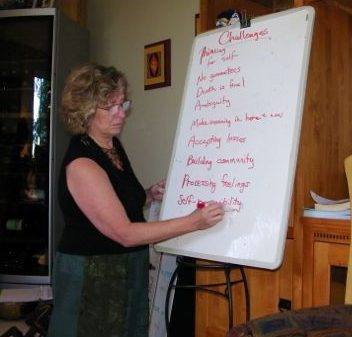
This is a YouTube series of 3 videos from Marlene’s talk at a retreat, explaining why she thinks the most important thing about accepting evolution has nothing to do with the Garden of Eden.  It’s about understanding ourselves for who we are – animals.  Just as Copernicus and Galileo helped us understand that the earth was not the center of the universe, much to the ire of Christendom, evolution brings our identity into perspective.  But it’s not merely humbling; it’s empowering.  Because when we understand our own brains in the context in which they evolved, we can take responsibility for our emotions and our reactive “instinctive” behaviors in a way that allows us to make mature, more enlightened choices that exemplify the best in us as humans, or hom0 sapiens.  Our brains have a long history and we are incumbent to know that history (evolution) if we are to behave well, i.e. humanely, and even have a chance to survive as a species.  Our cerebral cortex is capable of rational thought and mirror neurons are capable of empathy but only if we honestly recognize and learn to manage the overriding power of our “reptile brains.”   The same religious hubris that denies global warming can harm everyone on the planet by denying who we are.


Call me \”Animal\”: Evolutionary Psychology and Religion, Part 1 of 3


Here’s my talk on “Leaving the Fold” at the Exmormon Foundation Conference on Oct. 15, 2011 in Salt Lake City. It was a Keynote presentation but you can get most of it from this audio (1 hour, 44 min.). I think former Mormons are to be commended for making it out of such a controlling religion and powerful social system.


This article by Pete Walker is a good explanation of “emotional flashbacks” and complex PTSD, which result from childhood neglect and emotional abuse (common to RTS).  In essence, current stress can trigger old pain; recognizing the signs and learning to manage the emotional reactions is important for healthy functioning.  I think that this work provides valuable insights that coincide with my own approach with taming the “idea monster” and learning to actively care for one’s inner child.

http://marlenewinell.net/managing-emotional-flashbacks


Religious Trauma Syndrome (RTS) is a function of both the chronic abuses of harmful religion and the impact of severing one’s connection with one’s faith and faith community.  It can be compared to a combination of PTSD and Complex PTSD (C-PTSD).  In the last article of this series, I explained some of the toxic aspects of authoritarian religions that cause long-term psychological damage (Bible-based ones in particular).  In this writing, I will address the trauma of breaking away from this kind of religion.

Continue reading »


RTS article, part 2


Casting Off , by Anne Bokma.

For those who reject the strict religion of their childhood, it’s not cutting ties with their church that’s hardest. It’s breaking away from their devout parents.

Even as a young boy, Peter Scott knew he was out of place in the Pentecostal church he grew up in. While everyone else was speaking in tongues and having visions and being filled with the Spirit, I’d be sitting there waiting for God’s glory to fall on me and it never happened,” says the 43-year-old Vancouver man. “At the time I figured it was because I was such a sinner. I definitely felt like something was wrong with me because I didn’t have these experiences.”


Click on link above to read the rest of this article about dealing with religious family members. It’s by Canadian journalist Anne Bokma, who interviewed Marlene and quotes her comments about the subject.


With RTS, the social context is completely different from other trauma recovery situations.  Natural disaster experiences, childhood sexual abuse or family violence are all understandable to friends and professionals who are likely to be sympathetic and supportive.  In the case of religious abuse, a person is often hounded by family and church members to return, and reminded in many ways that they are condemned otherwise.  In essence, they are pressured to return to the perpetrator of their abuse.  Their suffering is not seen.  In fact, they are made pariahs when they do not return and this social rejection is an added layer of serious injury absent from other varieties of trauma.

Continue reading »